
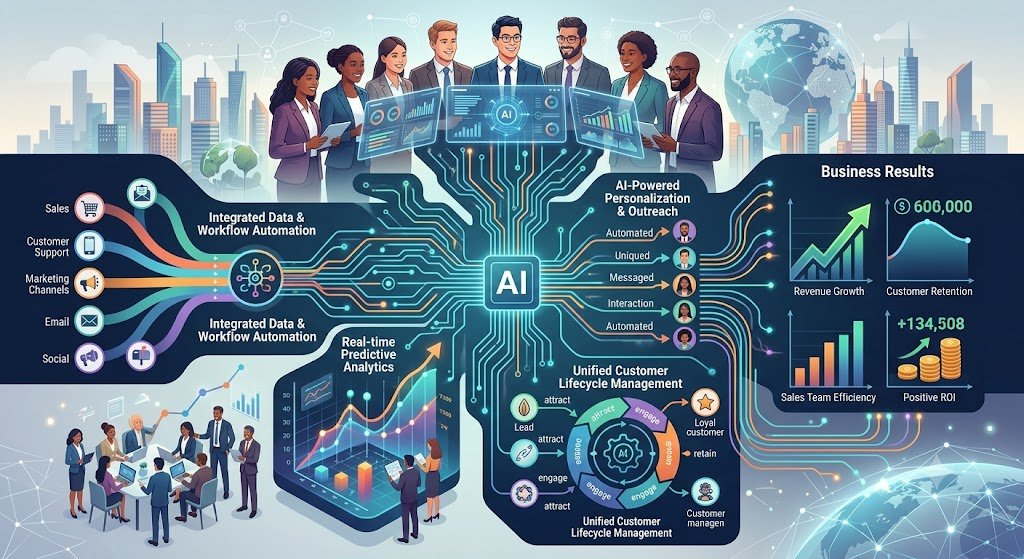
Modern businesses generate leads from websites, advertising campaigns, social media, email, referrals, calls and other digital channels. The real challenge begins after those enquiries arrive.
When leads are stored in spreadsheets, inboxes, personal devices or disconnected applications, sales teams may struggle to identify ownership, track conversations and complete follow-ups. Managers also lack a reliable view of what is happening across the sales pipeline.
An AI-powered customer relationship management platform can help address these problems by bringing lead information, follow-up activities, team assignments and performance insights into one organised system.
BZPulse positions itself as an AI CRM for capturing, organising and managing leads, automating suitable sales activities and improving visibility across customer interactions. This can make it relevant for healthcare providers, service businesses, sales teams, startups and other enquiry-driven organisations.
However, businesses should evaluate its exact features, integrations, privacy controls and commercial terms against their requirements before adopting it.
What Is an AI CRM?
A traditional CRM stores information about leads, customers, conversations, tasks and sales opportunities. An AI CRM adds artificial intelligence and automation capabilities that may help teams interpret information and decide what needs attention.
Depending on the platform and configuration, an AI CRM may assist with:
- Lead capture
- Data organisation
- Lead categorisation
- Follow-up reminders
- Activity summaries
- Sales-pipeline visibility
- Message drafting
- Lead prioritisation
- Workflow automation
- Performance reporting
- Appointment tracking
- Customer segmentation
Gartner describes AI in sales as the use of artificial intelligence in sales tools and processes to help sellers work more efficiently, simplify buyer journeys and improve customer experiences. Businesses can explore Gartner’s overview of AI in sales.
AI should support salespeople rather than make every decision independently. Human review remains essential for communication quality, complex enquiries, sensitive information and important commercial decisions.
Why Traditional Lead Management Is Becoming Inefficient
Spreadsheets and manual records may work when a business handles only a small number of enquiries. As lead volume and team size increase, weaknesses become more visible.
Common problems include:
- Leads being entered more than once
- Important enquiries being overlooked
- Follow-ups depending on personal memory
- Unclear lead ownership
- Inconsistent status updates
- Conversations scattered across different channels
- Limited reporting
- Difficulty identifying inactive leads
- No dependable sales history
- Managers requesting updates manually
- Leads remaining with unavailable employees
- Poor coordination between marketing and sales
These problems do not always mean that employees are careless. They often indicate that the business has outgrown its existing process.
A centralised CRM can establish one operational workflow for recording, assigning and reviewing enquiries.
Centralised Lead Information
One reason businesses adopt CRM software is to create a central source of customer and lead information.
A lead record may contain:
- Name
- Phone number
- Email address
- Company
- Source
- Product or service interest
- Assigned employee
- Pipeline stage
- Previous conversations
- Follow-up date
- Notes
- Appointment details
- Latest activity
- Outcome
BZPulse’s published materials describe the platform as a central system for capturing, organising and managing leads. When implemented correctly, this can reduce dependence on individual spreadsheets and make lead information available to authorised team members.
Centralisation is only useful when the information remains accurate. Businesses should define which fields are required, who can update them and how duplicate or outdated records will be managed.
Smarter Lead Capture from Multiple Sources
Modern organisations may receive enquiries from several channels simultaneously. Without structured lead capture, staff members may need to transfer information manually into spreadsheets or separate tools.
An AI CRM may help consolidate leads from supported sources, such as:
- Website forms
- Landing pages
- Advertising campaigns
- Manual sales entries
- Referral enquiries
- Imported lead lists
- Appointment requests
- Supported communication channels
- Connected third-party platforms
BZPulse may help businesses organise incoming leads through a consistent workflow, but prospective users should verify which integrations are currently supported. The availability of WhatsApp, email, telephony, advertising or website integrations can differ according to the product plan, country and third-party provider.
The objective is not simply to collect more leads. It is to make each legitimate enquiry visible, assignable and actionable.
Automated Follow-Up Support
Many leads are not ready to make an immediate decision. They may need more information, internal approval, budget confirmation or time to compare alternatives.
Follow-up is therefore an important part of lead management. A CRM may support the process through:
- Follow-up dates
- Task reminders
- Inactivity alerts
- Stage-based workflows
- Appointment reminders
- Reusable communication templates
- Automated acknowledgements
- Escalation rules
- Manager notifications
Automation can reduce repetitive administrative work, but communication should remain relevant and proportionate. Excessive or poorly timed automated messages may frustrate potential customers.
Businesses should also provide an appropriate way for recipients to stop marketing communication and should follow applicable consent and privacy requirements.
Better Lead Assignment and Team Accountability
In a growing team, every new lead needs clear ownership. If multiple employees assume that someone else will respond, the enquiry may be ignored. If several employees contact the same person, the business can appear disorganised.
A structured CRM workflow can help by showing:
- Who owns each lead
- When the lead was assigned
- The current stage
- The latest conversation
- The next scheduled action
- Whether a follow-up is overdue
- Whether the lead needs reassignment
- Who changed the record
BZPulse may help managers assign leads and review team activity through a central dashboard. This creates operational visibility without requiring employees to prepare separate status reports repeatedly.
Accountability should not become excessive surveillance. Organisations should communicate clearly about what activity is monitored, why it is necessary and how employee information will be used.
AI-Assisted Lead Prioritisation
Not every lead has the same urgency or likelihood of progressing. Some enquiries contain clear buying intent, while others may be early research, incomplete submissions or irrelevant requests.
AI-assisted lead prioritisation may examine available data such as:
- Source
- Product interest
- Engagement
- Recency
- Previous activity
- Pipeline stage
- Follow-up history
- Completeness of information
- Appointment behaviour
The system may then help salespeople identify leads that require immediate attention.
Any score should be treated as decision support—not objective truth. An AI model can inherit limitations from its training data, rules and historical business records. Teams should be able to understand which information influences prioritisation and correct inaccurate results.
High-value decisions should not be based only on an automated score.
Clearer Sales-Pipeline Visibility
A CRM pipeline represents the stages through which a lead may progress. A typical workflow could include:
- New enquiry
- Contact attempted
- Contacted
- Qualified
- Appointment or demonstration scheduled
- Proposal shared
- Negotiation
- Converted
- Lost or inactive
The exact stages should match the organisation’s real process.
BZPulse can potentially help teams view leads according to their current stage and identify where opportunities are slowing down. Managers may use this information to ask more useful questions:
- How many new leads arrived?
- Which sources produced relevant enquiries?
- How many leads are awaiting initial contact?
- Which follow-ups are overdue?
- Where are leads becoming inactive?
- Which team members need support?
- How many appointments were scheduled?
- Why were leads marked as lost?
Pipeline reporting becomes valuable when employees apply stages consistently and record outcomes accurately.
Faster Access to Customer Context
Customers do not want to repeat the same information every time they speak with a business. When authorised employees can review previous interactions, they may provide a more connected experience.
A useful CRM history may show:
- Original enquiry
- Questions already answered
- Products or services discussed
- Previous appointments
- Follow-up commitments
- Shared proposals
- Customer preferences
- Important concerns
- Communication history
According to Salesforce’s explanation of changing customer expectations, customers increasingly expect proactive, personalised and connected experiences across digital channels.
BZPulse may help teams access relevant context before responding. Personalisation should be based on legitimate business information and user consent—not intrusive profiling.
Reduced Repetitive Administrative Work
Sales professionals often spend time updating records, creating reminders, searching for previous conversations and preparing basic reports.
AI and automation may support administrative tasks such as:
- Creating follow-up reminders
- Updating workflow stages
- Summarising lead activity
- Identifying incomplete records
- Preparing message drafts
- Highlighting overdue actions
- Generating dashboard summaries
- Categorising enquiries
These capabilities can give team members more time for conversations, problem-solving and relationship-building.
Before automating a workflow, businesses should first make sure the underlying process is clear. Automation can accelerate a good process, but it can also reproduce a confusing process at a larger scale.
Why BZPulse May Be Relevant for Healthcare Teams
BZPulse’s published content places particular emphasis on patient lead management for doctors, dental clinics and other healthcare organisations.
A healthcare lead CRM may help administrative or patient-coordination teams organise:
- Appointment enquiries
- Requested services
- Preferred contact methods
- Assigned coordinators
- Consultation follow-ups
- Appointment status
- Enquiry sources
- Non-clinical communication history
Healthcare organisations must treat patient-related information carefully. A public enquiry form should not collect detailed medical history unless an approved and appropriately secured process exists.
Before using any CRM for healthcare, organisations should verify:
- Where information is hosted
- Which security controls are available
- Whether data is encrypted
- How access permissions work
- Whether activity logs are maintained
- Which regulations apply
- How long data is retained
- How information can be deleted or exported
- Whether third-party AI providers process the data
- Whether required contractual safeguards are available
A CRM should not be assumed to meet healthcare privacy requirements merely because it is marketed to healthcare providers.
Privacy and Security Must Be Evaluated Carefully
CRM systems may contain names, phone numbers, email addresses, business details, communication histories and other personal information. Security and privacy should therefore be central to the selection process.
The NIST Cybersecurity Framework provides guidance to help organisations understand and manage cybersecurity risks. OWASP also identifies common API security risks, including broken authentication and unrestricted resource consumption.
Businesses evaluating BZPulse or any AI CRM should ask about:
- Encryption in transit and at rest
- Multi-factor authentication
- Role-based access
- Password policies
- Session management
- Audit logs
- Backup procedures
- Incident response
- Data retention
- Data export
- Account deletion
- API protection
- Third-party subprocessors
- AI model data usage
- Data-hosting locations
Permissions should follow the principle of least privilege. Employees should only access the information required for their responsibilities.
Reporting for Better Decisions
A well-configured CRM can transform everyday activity into useful operational information.
Reports may help businesses evaluate:
- Lead volume by source
- Stage distribution
- Follow-up completion
- Appointment activity
- Conversion outcomes
- Lost-lead reasons
- Employee workload
- Average time between stages
- Inactive leads
- Campaign performance
Reports should be interpreted carefully. A high number of leads does not necessarily indicate a successful campaign if those leads are irrelevant or uncontactable. Similarly, conversion differences between employees may reflect territory, lead quality, product complexity or assignment rules.
BZPulse dashboards may support management visibility, but organisations should first define which metrics represent meaningful performance.
CRM Adoption Is as Important as CRM Features
A powerful CRM will not improve lead management if employees do not use it consistently.
Implementation should include:
- Defined pipeline stages
- Clear lead-ownership rules
- Required data fields
- Duplicate-handling procedures
- Follow-up expectations
- Role-based permissions
- Team training
- Management support
- Data-quality reviews
- Documented workflows
- A responsible AI policy
Salesforce’s current State of Sales report highlights the growing role of AI and agents within sales operations. However, successful adoption still depends on useful workflows, reliable data and employee participation.
Businesses should introduce automation gradually, measure its effect and adjust the process using real feedback.
How to Evaluate BZPulse Before Switching
Before migrating lead information, a business should conduct a structured evaluation.
Identify the Current Problems
Document the reasons leads are being missed or delayed. Avoid purchasing technology without identifying the process that needs improvement.
Confirm Essential Features
Create a list of required capabilities, including integrations, user roles, pipeline stages, reports, automation and data export.
Request a Demonstration
Use realistic scenarios during the demonstration rather than viewing only prepared examples.
Test with a Small Team
A limited pilot can reveal usability issues, missing fields and workflow problems before complete migration.
Review Security and Privacy
Request documentation about hosting, encryption, backups, access controls, retention and third-party processing.
Understand Pricing
Confirm user limits, feature restrictions, implementation charges, integration costs, support and future upgrade expenses.
Plan Data Migration
Clean existing data, remove unnecessary records and verify import/export formats before migration.
Define Success Metrics
Measure outcomes such as follow-up completion, record accuracy, pipeline visibility and administrative time—not only total conversions.
Questions to Ask During a BZPulse Demo
Businesses can ask:
- Which lead sources can be connected?
- Can the pipeline stages be customised?
- How are duplicate leads identified?
- Can leads be reassigned automatically?
- Which activities can be automated?
- How does AI prioritisation work?
- Can employees correct AI-generated suggestions?
- Are detailed audit logs available?
- How are user roles and permissions configured?
- Where is customer data stored?
- Is customer information used to train AI models?
- What data-export options are available?
- What happens after cancellation?
- Which reports can be customised?
- What onboarding and support are included?
Clear answers help businesses determine whether the platform matches their operational and regulatory requirements.
Why Modern Businesses Are Considering BZPulse AI CRM
Modern organisations need more than a digital address book. They need a structured system that can make every legitimate enquiry visible, assign responsibility, support timely follow-up and provide useful management insight.
According to its published materials, BZPulse focuses on:
- Centralised lead management
- AI-assisted workflows
- Follow-up automation
- Sales-pipeline visibility
- Team coordination
- Customer interaction management
- Healthcare and patient-enquiry workflows
These capabilities may make BZPulse worth evaluating for organisations experiencing lead leakage, inconsistent follow-ups or limited pipeline visibility.
The decision to switch should still be based on a practical demonstration, feature verification, privacy review, security assessment and pilot implementation.
Build a More Organised Lead-Management Process with BZPulse
AI CRM technology can help businesses reduce manual work and create a more consistent lead-management process. Its greatest value comes from combining useful automation with clear workflows and responsible human oversight.
BZPulse may help organisations capture enquiries, organise lead information, coordinate team responsibilities, schedule follow-ups and review the sales pipeline from one platform.
Businesses interested in exploring the platform can visit the official BZPulse website and request current product information or a demonstration.
The objective should not be automation for its own sake. The goal should be a lead-management system that helps employees respond more consistently, gives managers reliable visibility and provides customers with a better-organised experience.